

We’ve seen it all when it comes to auction revenue goals, from over-ambitious event planners to nonprofits who undervalue their items and aim too low. Goal setting can be complicated, especially if you don’t understand how much revenue your auction items can truly bring in.
To set proper expectations of an auction goal, it’s important to understand what is realistic for a silent auction to generate in terms of revenue. It is possible to be relatively accurate, but only if you understand key principles and misconceptions about silent auctions. We’ll cover the basics of auction revenue goals here to give you a better idea of how much your organization can make.

Common Misconceptions About Auction Revenue
1. Auction revenue will exceed your items’ fair market values.
To understand this frequent misconception, we first need to define fair market value (FMV):

The fair market value is the price a buyer would pay for a specific item on the open market. For some items, this is easy to determine (e.g., a $100 gift card to a local restaurant has an FMV of $100), but it can be rather subjective for others.
Accurately determining the FMV is probably the single biggest factor in determining auction revenue potential. However, that doesn’t mean that FMV is a one-to-one indication of how much revenue you can expect to bring in. The reality is a little more complicated, since the prices winning bidders pay for auction items can vary drastically. If every guest wanted to pay $100 for a $100 gift card, they wouldn’t be at an auction!
2. Most bidders place bids above the FMV.
One thing to understand is that silent auction bidders are bargain hunters. This means that most are looking for a deal and expect to pay less than the FMV of your auction items. Even if the FMV of the item is not well known, each bidder has an opinion of what they think the item is worth. This opinion of the item’s value will influence their maximum bid if they opt to place one, and they likely won’t want to pay more than that.
3. Item donors will provide accurate FMVs.
Item donors should always provide FMVs for the items they provide, but these estimates might skew your FMV calculations. Donors have been known to inflate the value of the items they donate for tax purposes.
Keep this in mind when setting goals (and starting bids!). While a necklace donated from a jeweler might have a $4,000 price tag, your bidders may only believe it is worth $1,000. Make sure to do some due diligence to determine what similar items sell for online or at other stores before you set a goal you can’t possibly meet.
4. Handmade and rare items are easy to price.
Handmade and rare items can also throw off your FMV calculations and auction revenue goals. If your auction is full of handmade items (e.g., art, jewelry, crafts, or class projects) or unique experiences (bowling with a teacher or meet-and-greets with a celebrity), these can be really difficult to value.
In many cases, the most accurate value of the item is the cost of the materials used to make it (e.g., the canvas artwork with the kindergarten class’s handprints). Expect to estimate a final price for these items and adjust your goals accordingly.
The Truth About Auction Revenue Expectations
The truth is that auction item FMVs will impact your auction’s potential revenue, but maybe not in the ways you think. In reality:
- You should not expect to earn more in revenue than the sum of all your items’ fair market values.
- Bidders often want to pay less than your items’ FMV to get a deal.
- The amount winning bidders ultimately pay will vary drastically, so you can’t predict a set amount for each item.
- Inaccurate or overstated FMVs can cause bidders to lose trust in your nonprofit.
It’s best to provide your auction guests with transparent, accurate estimations of each item’s value so they can make informed decisions.
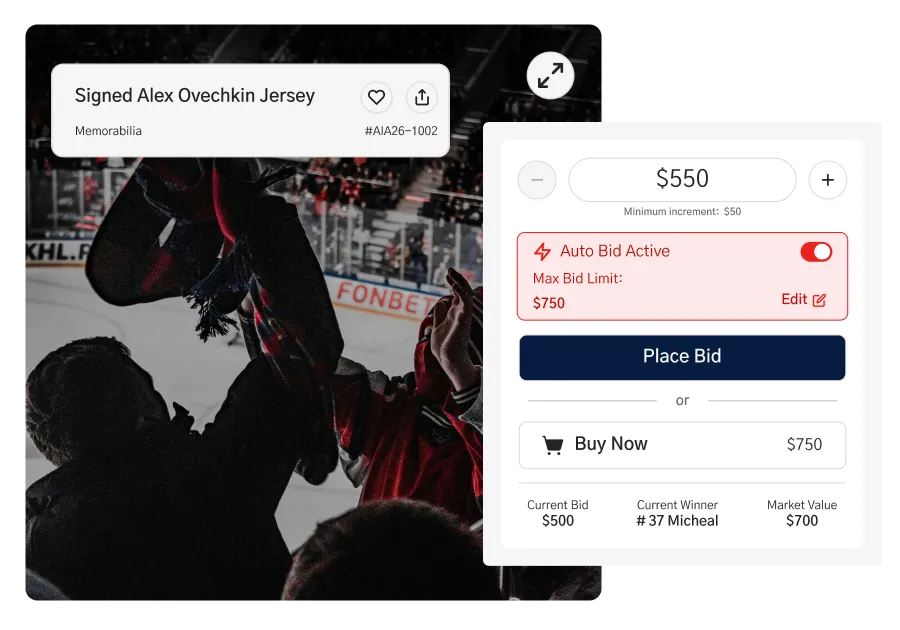
Even if you don’t provide your own estimates, bidders will likely tell you how much they think an item is worth. One distinct advantage of mobile bidding is that you can easily gauge bidders' opinions of an item's value by looking at the Max Bids on the item. For example, the bidder below set their maximum bid to $750 for an item valued at $700:
How to Set Realistic Auction Revenue Goals
To improve your auction revenue goal-setting with these considerations in mind, follow these steps:
- Adjust FMVs for accuracy. List your items and, in a column next to the FMV, either copy over the FMV if it is accurate or adjust the value to be more accurate. You won’t change the FMV on the item for reporting purposes; this is just to estimate your revenue goal.
- Add up those values. When you are done listing out the FMV of all items up for auction, calculate the sum to get your Adjusted FMV.
- Set goals based on our rules of thumb. In general, paper bidding often generates 40–50% of our Adjusted FMV, while mobile bidding garners 70–80%. Many of our clients see their auctions perform in the 70–80% of adjusted FMV range or higher (especially if they follow our advice on how to properly set starting bids and bid increments).
If you are being conservative or if this is your first silent auction with mobile bidding, set your goal to 70% of your adjusted FMV. If this is not your first year doing mobile bidding, consider being more aggressive with your goal and shoot for 80%.
Pro tip: FMV isn’t the only number that matters! Your starting bids and bid increments can significantly impact auction revenue, so don’t set them too high.

We've generally found success setting bid increments equal to 10% of the starting bid price for most items below $1,000. For items over $1,000, we advise our customers to set bid increments of less than 10% of the item. So a $500 spa day would have bid increments of $50, and a $2,000 vacation package should have bid increments less than $200.
Pitfalls to Avoid When Setting Auction Revenue Goals
Just because your auction earned $20,000 last year does not mean it will do the same this year. For example, if you had 150 items last year and averaged $133 per item, and this year you have only 100 items of similar value, it would be hard to exceed $20,000.
Be sure in all cases to add up the FMV, make any adjustments (positive or negative), and set a goal as a subset of that amount.
If your goal is 75–80% of FMV, avoid factors that will prevent you from hitting that percentage. These include:
- High starting bids
- High bid increments
- Short auction times
- Poor item descriptions
- Bad item displays
At Handbid, we cover all of these factors in our training with clients to set them up for the best auction performance.
How Handbid Handles Auction Revenue Goals
Goals are important to us here at Handbid. We use them to measure how well we do across all areas of our business, and we encourage our clients to do the same when setting up their auction in our system.
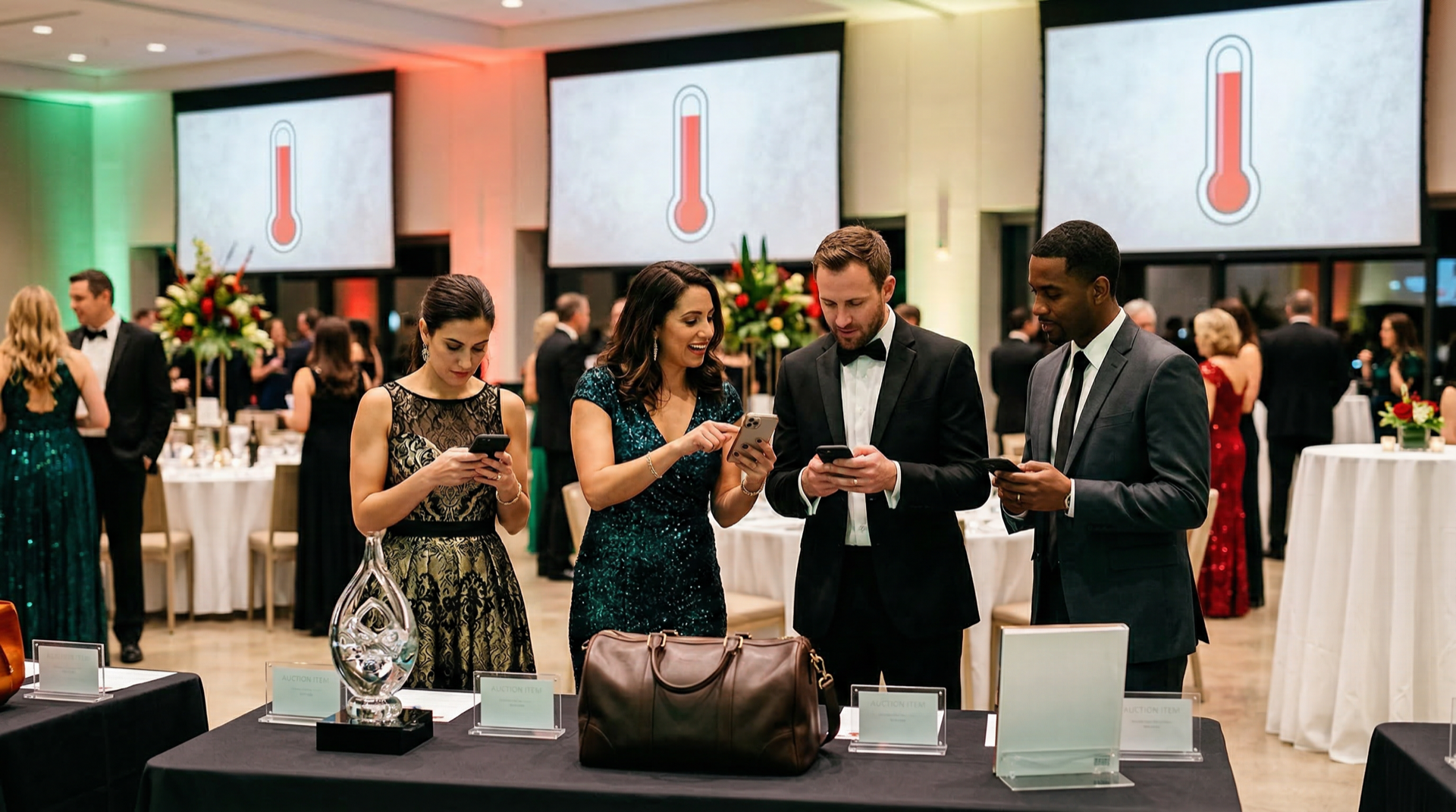
In fact, all of the thermometers on display in the Handbid software are inspired by the real revenue goals set by our clients.
For all Handbid customers who request on-site help with their event, we run through a kick-off process to ensure they consider and plan for essential elements in their auction.
If you want a recipe for running an auction, consider our consulting services.
Final Thoughts
Setting realistic expectations for silent auction revenue is an essential part of the planning process. Failing to set expectations could overestimate the ROI of your event, potentially leading to budgeting issues down the road. Follow the tips and principles in this article to ensure your revenue goals are realistic and attainable.