

Ever been to a charity auction and seen those autographed sports items or a guitar signed by a famous rock star? Better yet, have you been asked to bid in a live auction on a European vacation or a trip to New Orleans for Mardi Gras? Ever wondered, "Wow, how did a nonprofit get that kind of item donated for their event?”
More often than not, those items are offered on consignment. Consignment auction items are extremely popular, but are they a worthwhile addition to your next event? Let’s discuss some common questions and important factors to consider.

What Is Auction Consignment?
Auction consignment is a process by which third-party providers offer specialty items or experiences to sell at your auction. These items typically have a base or reserve price that your organization pays, and any money raised above that cost goes to your nonprofit. However, keep in mind that if the item sells at or below the reserve price, you may receive $0.
Consignment Auction Items vs. Donated Auction Items
Having another company fill your auction with amazing items may sound like a great idea compared to soliciting items on your own, but it comes with some drawbacks. Check out this quick breakdown of the differences between consignment and donated auction items:
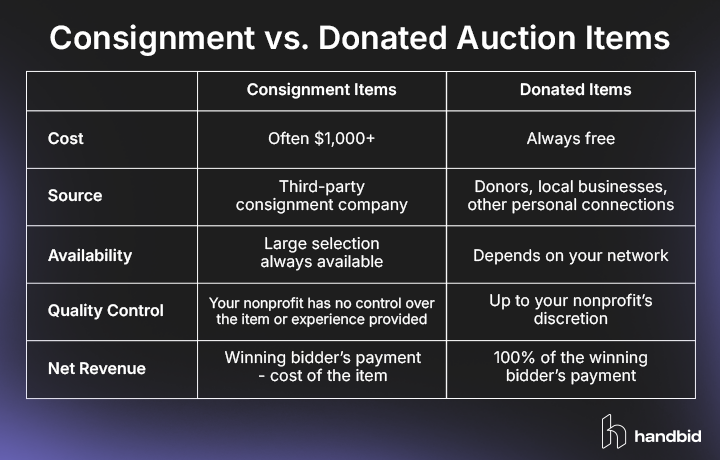
- Cost: Consignment items are often priced at over $1,000, while donated auction items are always completely free.
- Source: You can easily purchase consignment auction items from a dedicated consignment company. To source donated items, you’ll have to pull from your organization’s network of donors, business sponsors, and connections.
- Availability: Consignment companies typically have hundreds of items available at all times, while the availability of donated items depends on your network.
- Quality control: Since consignment items are provided by a third party, your organization has no control over the item or experience’s quality and cannot guarantee its value. With donated items, it’s up to your nonprofit’s discretion whether to offer them if they don’t meet your quality standards.
- Net revenue: When someone wins a consignment item, you must subtract the item's cost from the payment before your organization receives any net revenue. When bidders win donated items, 100% of the proceeds go toward your mission.
How Does Auction Consignment Work?
Typically, the consignment company does most of the work, and your charity gets 30-40% of the proceeds. The company sources the items, curates the experiences, and packages up their offerings for anyone to buy. You browse the company’s catalog and choose an item to include in your auction. Then, when someone wins the item, the company handles all fulfillment.
In a basic example, here’s how the math might work:
- The consignment vendor provides your auction with two items: a signed football helmet from a famous sports star in your area and a guided African safari for two people. You put the helmet in your silent auction and the safari in the live auction.
- The reserve price on the helmet is $400, and the vendor recommends you start bidding at $500 with $50 bid increments. You also set a buy-it-now price of $800, hoping it will be a popular item that sells at or near that $800 price.
- In the end, the helmet sells for $550 with only two bids. A bit of a disappointment, especially considering that your cause will only realize $150 in profit, with the $400 reserve going back to the consignment vendor.
- With the African safari, you start bidding at the reserve price of $2,500, hoping it will go for thousands more. You haven't hired a professional auctioneer, and your step-in volunteer is struggling to get many bids above $3,000. Finally, the item settles at $3,500, netting only $1,000 for your organization.
Even though most consignment items are touted as “risk-free” (since you don’t have to pay anything if the item doesn’t sell), the truth is that they might not earn much, or anything, for your organization.
Are Consignment Auction Items Worth It?
Whether consignment auction items are worth it for your nonprofit depends on your resources and goals. Before you decide to go this route, however, understand the impacts that consignment items can have on your auction. Remember, these companies are running a business, not offering items for free.
On the surface, consignment items can look fantastic. In our scenario above, the example nonprofit collected over $4,000 at checkout. If the goal was simply to increase total revenue, this could be an easy way to do it. However, we all know that your event’s success depends on what you ultimately put in the bank (the net revenue), and in this case, these items pulled $4,050 out of your bidder's pockets but only delivered $1,150 to the charity.
To add insult to injury, most bidders don't even realize that this is the case, thinking that they have donated a substantial amount to support your cause. This misunderstanding and the low returns make auction consignment not worthwhile for many organizations.
Common Types of Consignment Items for Charity Auctions
Consignment auction items are often meant to act as show-stoppers. These are the types of options you can usually choose from:
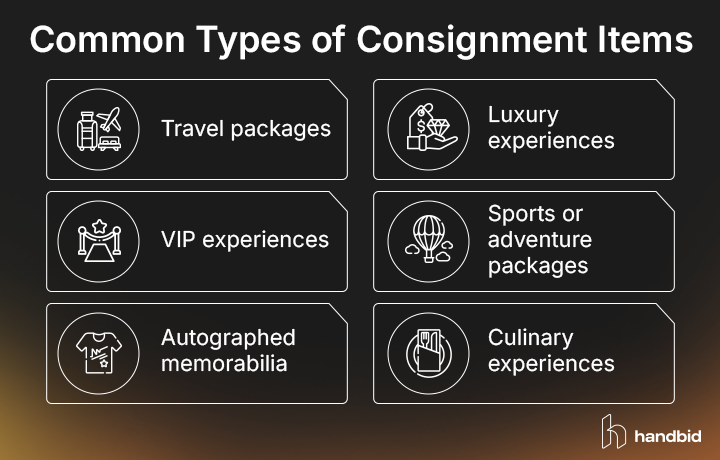
- Travel packages
- VIP experiences
- Autographed memorabilia
- Luxury experiences
- Sports or adventure packages
- Culinary experiences
There are hundreds of variations on each of these items, and these aren’t the only options. Many consignment companies actually allow you to customize packages and design your own experiences to auction off (for an additional fee!).
Consignment Auction Item Considerations & Tips
With everything we’ve discussed above in mind, it’s ultimately your decision whether to offer consignment items or not. If you do, follow these guidelines to consider how to best use consignment items to your charity's benefit:
Prioritize distinctive consignment items for silent auctions.
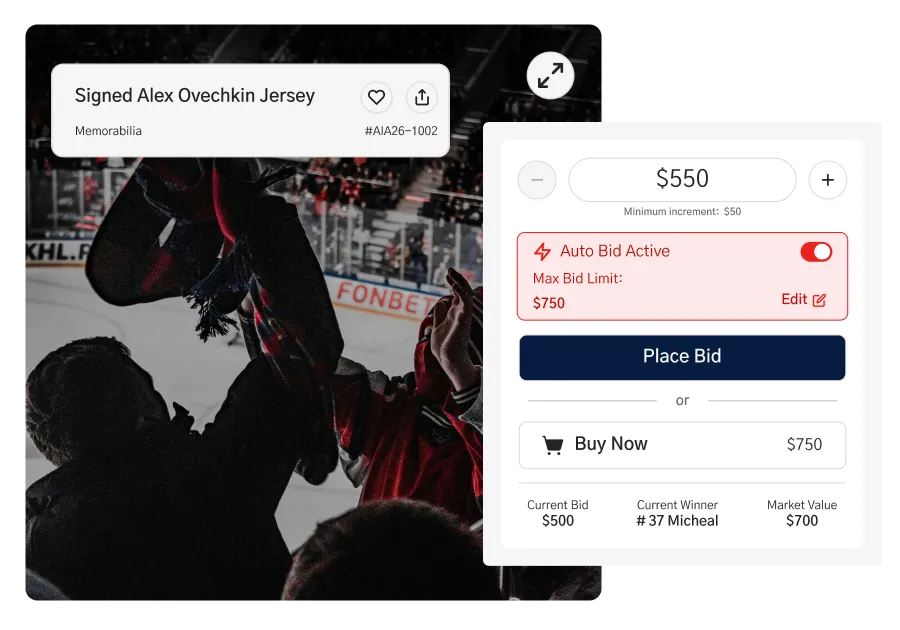
Silent auction bidders are typically bargain hunters. They know what many items are worth and are looking to purchase things at or below their fair market value (FMV). The only way to avoid this behavior is to offer items in your silent auction that can't be found elsewhere. Most consignment items are easily found online, and their values are simple to determine.
In the case of the football helmet, assume a quick online search reveals multiple similar helmets available for $400 to $500. It should come as no surprise that the helmet would not go for much more than this amount.
Therefore, your best bet is to ensure that any consignment items you offer are particularly unique and cannot be acquired elsewhere. A great example of this is personalized items or customized experiences. For instance: meet the football star, take your photo with them, and then get him to personalize the signature on the spot. Include these details in your online auction catalog to make your items stand out even more.
Use consignment items sparingly in your live auction.
These should be once-in-a-lifetime items that can generate a "wow” factor and incentivize bidding. These items can work with your live auction crowd, whose competitive spirit (and pocketbooks) will allow them to bid on items well above their value.
We recommend offering one or two consignment auction items max to engage your crowd and add some excitement to the live auction. If you use too many consigned items, you risk losing revenue from your bidders who would have been just as willing to donate a similar amount directly through an appeal.
Don't hide behind the reserve price.
When you auction off these consignment items, make it clear to donors what your charity will actually earn from them.
We’ve seen many angry bidders realize too late that their $4,000 purchase yielded only $1,500 for the charity. Some guests even argue that they would have been more than willing to write a $2,000 fully deductible check instead. Keep your bidders happy and informed to avoid these scenarios.
The Verdict on Consignment Items for Charity Auctions
There are plenty of companies out there that will tell you consignment auction items will significantly increase your top-line revenue and remove the burden of having to acquire all of these items on your own. It can sound enticing, but it also comes with drawbacks. The real question is, what will generate the best returns on your investment?
At Handbid, we will always show you how your dollars invested in our services result in higher net revenue for your charity. Ask these consignment providers to do the same.