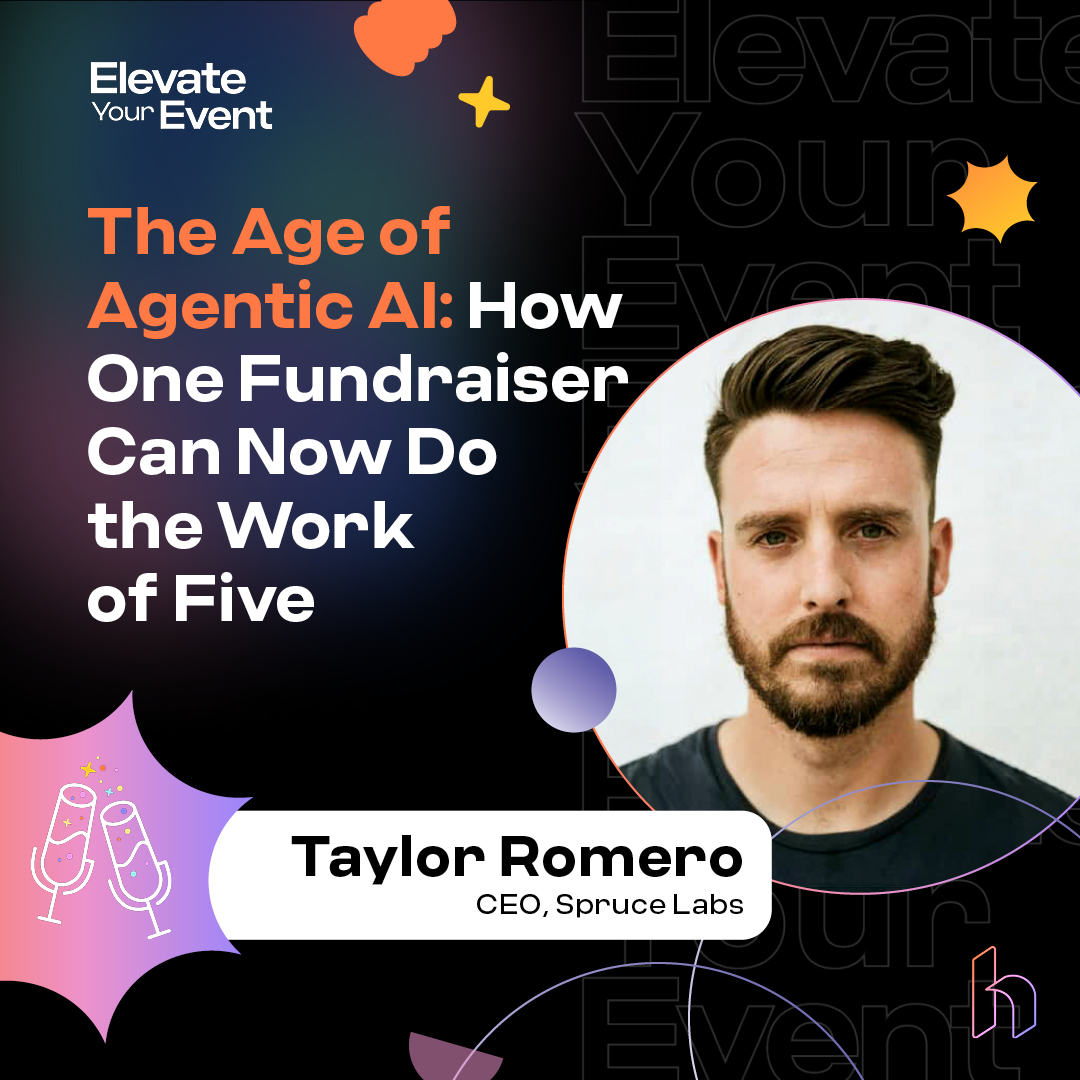

AI isn’t just writing emails anymore—it’s reshaping how nonprofits plan events, engage donors, and run their entire fundraising operation.
In this episode of Elevate Your Event, Jeff Porter and Mark Laba are joined by Handbid’s VP of Software Development, Taylor Romero, to unpack what “agentic AI” actually means—and why it’s a game-changer for lean nonprofit teams.
From automating sponsorship outreach and auction procurement to rethinking guest check-in and event analytics, the conversation explores how AI can make one fundraiser as effective as a team of five—without losing the human touch donors care about most.
If you’ve been wondering where to start with AI (beyond rewriting emails), this episode gives you practical ideas you can try right away.
What You’ll Learn in This Episode
1. AI won’t replace fundraisers—it will multiply their impact
Agent-based AI systems can now automate donor outreach, sponsorship follow-ups, and auction item solicitation—tasks that traditionally take weeks of manual effort.
“AI doesn’t replace the fundraiser. It makes one fundraiser as effective as a team of five.”
2. We’re moving from building software to growing it
Taylor explains a powerful mindset shift: instead of engineering software feature-by-feature, organizations are learning to guide AI systems that evolve solutions organically.
This opens the door for smaller teams—and even non-developers—to create tools tailored to their workflows.
3. Conversational interfaces will reshape event operations
Think beyond forms and dashboards.
Future event tech interactions will increasingly happen through:
- chat
- voice
- automated assistants
- real-time conversational workflows
That means easier guest list updates, smoother check-ins, and fewer day-of-event headaches.
4. AI already helps automate fundraising workflows today
Jeff shares real examples from a live campaign where AI helped:
- identify past donors
- analyze email history for outreach candidates
- build targeted email sequences
- remove donors from follow-ups once they gave
- identify potential sponsors
- draft sponsorship outreach emails
- recover 70% of prior auction items—in one week
These aren’t future tools—they’re available now.
5. Data insights after your event are about to get much smarter
Instead of static reports like “top bidders” or “ticket sales totals,” AI can now surface insights like:
- emerging donor behavior trends
- engagement shifts from last year
- pricing strategy effectiveness
- sponsorship performance patterns
- hidden opportunities your team may miss manually
Even better? It can package those insights into board-ready presentations in minutes.
6. The biggest mistake nonprofits make with AI
Most teams are still stuck using AI like this:
“Rewrite this email.”
Instead, the opportunity is:
“Plan and execute this outreach strategy.”
Agent-style tools like Claude Co-Work or Perplexity Computer can already handle multi-step workflows automatically.
Practical Ways to Start Using AI This Month
Try one of these immediately:
✅ Build a donor re-engagement email sequence
✅ Generate sponsor prospect lists
✅ Automate auction item request emails
✅ Analyze last year’s event performance trends
✅ Create board-ready reports in minutes
✅ Test a conversational workflow for guest updates
Start with the why, not the how—and let AI help design the solution.
A Big Idea to Leave You With
For 15 years, nonprofits have learned how to use event software.
The next 15 years will be about software that learns how to work for you.
Connect with Handbid:

https://www.instagram.com/handbidauctions/
https://www.linkedin.com/company/handbid/
View Transcript
Mark: Mark. We are back. We are back better than ever.
Jeff: I know. Oh my God. It's been a while since we've done one of these podcasts.
Mark: I know, dude. I know. But we [00:04:00] got, we got Taylor with us today. I know,
Jeff: which is
Mark: awesome.
Jeff: There, we got a special guest and I will, I will tell you, um, at the same time our, uh, our brief little, um, what do you wanna call it? Sabbatical?
Yeah. Was intentional as we're trying to kind of figure things out and, and a lot of the work we've been doing in Ham over the last couple months is the topic of today's conversation.
Mark: Oh yes. Yeah, well, I mean, well, I feel like we're coming into a whole new level of ai, right? Like, yes, three years ago it was kind like, oh, cool, look, I can ask just chat bot to write my email for me, and it would do it.
Really cool. And then slowly but surely, people started using Claude and. Gemini and all these other types of platforms in order to start doing work for them. And so now this conversation is changing. It's
Jeff: changing
Mark: the future's age agentic, my friends.
Jeff: It is. And we brought in an expert.
Mark: Let's go.
Jeff: Okay. So Hamid's, VP of Software Development, Taylor Romero, has uh, graciously agreed to join us today to talk about [00:05:00] all of the amazing AI technology changes that are afoot, not just at Mbit, but I think in the industry in general.
Yes.
Mark: Yeah.
Jeff: Alright. Big shift. Taylor. Thanks for coming. Yeah, right on. Glad to be here.
Mark: Well, I, I wanna know real quick, Taylor, um, how long, like, like how long have you been in coding or like how did you get into the industry and like, just to set some background of what kind of questions I can throw at you.
Taylor: Yeah, right on. Let me maybe just give an abbreviated version of the beginning to today. So started, I'd been doing software for 28 years.
Mark: Okay.
Taylor: Started, got my first project when I was 14 for the district attorney in Huntsman, South Dakota. Nice. Okay. True fact. The hardest part of that project was. The programming, the dial up modem to connect.
Mark: Oh yeah.
Taylor: The mode books out and like, is
Mark: this, is
Jeff: this 50?
Taylor: I remember that. KI dunno. Oh no, dude, that's like three times what I, I started like seven points something.
Mark: Yes. [00:06:00] Nice.
Taylor: So, um, spent a lot of time building software along the way. Started to really realize the difference between building great software and building a team that builds great software.
Those are not the same thing.
Mark: Right?
Taylor: It wasn't intuitive to me. Okay. But let me define great software. So great software has three characteristics as I think people love to use it. Engineers love to build in it, and the more an engineer builds in it, the faster they and the software gets. So if you're working on software it, if it's not getting faster, the more you're building on it.
If it's getting slower and slower and slower, or buggier, buggier, buggier something, it's not great.
Jeff: Right?
Taylor: So I am spending time learning how to run teams that build great software and chat and chat. GBT two comes out.
Jeff: Okay,
Taylor: well, it's version two. Yeah, but it's
Jeff: T GT two is what they call it. Yeah. Yes. That was the big, big, big milestone.
Yes, I
remember
Taylor: that. So I, I start to play with it. And I start asking questions and I'm like, wow, this [00:07:00] is like, this is really cool. This is a big milestone. Also, its answers are kinda stupid. Let me push back a little bit as if I would with a human. So I call it a comprehension check. I'm not checking to see if you're right or wrong.
I'm checking to know if you know what you're saying.
Mark: Mm.
Taylor: And how you answer and the form of your answer and the shape of it. What I find is after doing an exercise like that. I can tell if you've thought about something, 'cause your answer will not change.
Mark: Right.
Taylor: But if I'm asking questions and your answers change, it's like, okay, just the first time you, so I'm pushing a, I'm pushing GPT two and I'm like, oh, you didn't think about this.
You just tell me an answer. And I'm starting to push on it and realizing like, oh my gosh, the, the same things that work with people. And how to drive better outcomes works with this ai. That's one of the signals to me, is like they're onto something.
Mark: Right.
Taylor: The other way I know they're onto something is if you've ever seen AI slop videos?
Mark: Yes.
Taylor: Yeah. Isn't that like dreams? Oh, that's a lot like dreams.
Mark: Will Smith eat spaghetti? Yeah.
Taylor: And it's just like's, just,
Mark: yeah.
Taylor: And in your dreams. You [00:08:00] reflect on it and you're like, wow, that was ridiculous. But in my dream, it made total sense. Yes. Yeah. And so like there's all these signs that like, wow, we're like tapping into something fundamental here about how intelligence works.
So it was 10 weeks ago we're doing work for, uh, getting a release out at HandBid. I'm, a fundamental shift happened to me when I was thinking about architecting the tools that we're building. I thought, what if, instead of thinking. Or, uh, architecturally, like you designed software. What if I thought operationally and I did actually lean into this idea that AI is people.
Jeff: Hmm.
Taylor: And so by thinking about it that way, because here's what we commented on about working with AI is like working with an idiot savant. Yes. Like I fixed your flex capacitor. And I'm like, dude, that's so awesome. But like you gotta get dressed when you come into the office. Like you cannot come like that.
And so I thought. What is the minimum [00:09:00] amount of organizational hierarchy you would need to deliver software if everybody on the team was an idiot savant?
Mark: Mm.
Taylor: And so I rearranged some things. I turned it on and the best way I can describe it is like, imagine it's horse and buggy days.
Mm-hmm.
Taylor: And I'm like really good.
Like you need to get somewhere. You get on my buggy, I know where all the potholes are. I got, I got refreshments. I know the fastest routes around town. Like I got you.
Mark: Yeah.
Taylor: And then an automobile drives by and I'm like, shoot.
Mark: Yeah.
Taylor: Like I got two options. I can fight for the horse and buggy, or I'm gonna go build one killer automobile.
Mark: Yeah.
Taylor: So I remember the system that we built. I turned it on, I watch it get two weeks of work done right in front of me. And I take a step back and I go, I'm out of a job. I'm never gonna, I'm not gonna code again. This is like, this was the, the moment everything shift shifted. And so we start to deploy and play with these things in HandBid and we kind of, if you imagine like a throttle, right?
Right now, I think the most throttle, like we've, if [00:10:00] it's like zero to 10, I think the most, we level three. Throttle this thing up as like a five, and it's the metaphor you can think of is a five-year old with a fire hose,
Jeff: but it's a very smart 5-year-old. I mean, the thing about, it's funny. Yes, we, we turned on the wild West.
Like is, is what we ultimately did. And it was fun to watch. It was really enlightening, but it was really a mess to clean up. So and so, like what does that really mean? People are listening to this are like, what, what the heck are you talking about? Because what, what Taylor's describing is a scenario where it was a fundamental shift.
Developers, like if you kind of think up through the progression of software development using AI tools, right? And, and there's probably a parallel in. Marketing and sales and everything else, and it's like, I'm gonna have it like edit my email, right? I mean, do you. People are like, I think a lot of my family members are still in like, I call it stage one.
Yeah. [00:11:00] Like have chat sheet pt, like rewrite your email and make it sound better. Right. Well, on the coding side, that there was a lot of auto complete there. Mm-hmm. Like, you're sitting there and you're typing and you're in a, what's called an IDE, but like a, a software development environment. And you're coding, and as you're writing code, the AI engine is suggesting, like, it'll just suggest the entire rest of the function.
You gotta write. And you're like, well, that's really cool, right? And then you're reading it and you're like, okay, but I wouldn't do that. And that that would change. And it was okay, and it was somewhat helpful. But where that's evolved to Taylor's point is you, you start there, but what became very obvious is these AI agents know way more about
Taylor: every
Jeff: domain.
PHP, every domain objective, C domain, Python, Python, it doesn't matter. They know way more about all of those. Then any programmer has in their head.
Taylor: Right?
Jeff: Because they have like, they, but, but what they don't know [00:12:00] is how to properly implement, use it. Yeah. And so that's where we started and, and I think. You kind of fast forwarded a little bit to what we create, you know, kind of the chaos that was created by what you built.
But, but what, what he learned very on early on is I can send off Claude or whoever. Okay. And we use Anthropic tools here for the most part, but I could send Claude off to go code something for him. Yeah, but if I'm not paying attention to it, a couple things will happen. One, it will decide on its own how to do it.
And that I would say a vast majority of the time is, is fairly correct. Although sometimes you have to remind it about things. That's the bigger issue is it forgets what you told it.
Taylor: Right.
Jeff: And it's like they call these context windows, right? But you have this thing where it's like, wait a second, I gave you these instructions.
You go off to do the work. Yeah. Somewhere in that process of doing the work, you completely forgot what I told you. You can and [00:13:00] can't do. Mostly the can't do. Okay. Yeah. And it comes back like, Hey, look at me. I finished. And you're like, it doesn't work. And it also violated exactly what I told you not to go do.
Mm. And so what Taylor had to go build was an orchestration model where there's ai, managing ai like is literally somebody. Micromanaging these agents and constantly reminding them of the rules.
Taylor: Most important things.
Mark: Yeah.
Taylor: Yep. I think another way that these things are idiots is. You imagine you ask AI to fix the flat tire on your car and then it comes in and is like done and you're like, let me go see.
And you go out there and your car has no tires.
Mark: Yeah.
Taylor: And it's like I solved it forever for you.
Jeff: Right. You'll
Mark: never have a flat tire. Yeah, that's true. That's true.
Taylor: You did. You did. But like, come on.
Mark: Well why I ain't gonna Lies to you when I'm like, Hey, set a timer for 15 minutes [00:14:00] and then I put something in the oven and then I like ask it.
Hey. How much time I have to my timer. It's like you don't have a timer. It's like you just said, you started a timer for me.
Jeff: Okay. One of the things that they're not good at is dates and times. So Yeah,
Taylor: it's universal. I, I had to give, I had to give our systems access to machine time.
Jeff: Yes.
Taylor: Very early on.
Mark: Yeah.
Jeff: You have, they have to, they have to ask a computer. I mean, and, and those are the things that you learn over time. Like what is this thing good at and what is it not? And, and so you kind of have to like keep that in the back of your head when you're asking it to do things. But what it's also gotten better at is as we pick on it for forgetting things, it does okay.
But at the same time, it's gotten better at structuring its own memory systems so that it tries to remember as much as it can.
Mark: Yeah.
Jeff: So six months ago, you're constantly reminding it about not just your code base, but how it, how it's constructed, and how it's organized, and what your rules are. It's [00:15:00] starting to remember most of those 'cause.
Yeah. Not because it's necessarily getting smarter. I mean, the models are getting smarter because it's storing that information on your computer in certain ways and it's constantly recalling that information. So that one, that part actually does help. The other point you made though, and Taylor was, you know, kind of giving the, the funny analogy of the flat tires.
These things are incentivized to finish the task. Mm-hmm. Yeah. And so you have to be careful. That's why we, what we've built what we call guardrails because it will cheat to finish the task.
Taylor: It has no feeling. So it's not embarrassed by doing something stupid.
Jeff: Right,
Mark: right. It's not worried if you're gonna judge it later on.
Taylor: Well, and what I learned from working from this is like, it is really nice working with intelligences that don't feel 'cause it's very productive. You can be very direct. But what I realized from working with ai. With the mistakes that it's made. I thought to myself, if you could be embarrassed by this, yeah.
Wouldn't never done it. You would never do it again. Right. And then I realized [00:16:00] feelings are long-term, low resolution memories. Mm. And without that, this AI does not have that. So when we experience something, we feel it in our body that long term, but it's low resolution, but it's enough to bring it to attention.
AI is good if you can bring something to its attention, but without feelings. It doesn't have that long-term low resolution callback.
Mark: Yeah. Sense.
Jeff: So Makes sense. So let's, so tell me, Taylor, like we've, we've kind of described kinda where we're at, but where does, and we need, we do need to come back to the mess that we made, that we had to clean up.
Yeah. We'll come back, but like,
Taylor: we're almost through it where.
Jeff: Where do you see the future of software development going? Yeah, based on this,
Taylor: well, the mo the, the most I could do is describe how the fundamentals have changed in an analogy. And then from there we can hypothesize if I am right, what could happen.
So it's very, very fundamental the way I think about what's changed. You no longer build software, you grow it.
Mark: [00:17:00] Hmm.
Taylor: Building is a very engineering piece by piece. How do things work? How do things connect? Process? Growing is organic. It means that you're watering it in a certain direction, so it'll go in a direction and then you try to correct it and it doesn't immediately correct.
You start to nudge it back in a direction. And it's interesting is I was showing someone what we built and they were watching it run and they're go, then they go, Taylor, it talks like you talk. I'm like, I didn't tell it to do that. So imagine too, like this culture that's building in this simulated landscape.
Yeah. It takes on your
Mark: personality.
Taylor: Yeah. Now imagine if I, what would be a fun experiment is we set up two copies of it and with the same requirements, and one of them we were positive reinforcement, one were negative. And what would that do to the outcome? Mm-hmm. Think of it like, it's like idiot savants, more like people.
So if you think about now we, we don't build software, we grow it. What does that unlock? That means to build something that is one bar of skill to grow something's [00:18:00] different and you can learn how to grow. I can learn how to grow a flower very fast if I just know the basics about the soil and the timing and the watering and software's turning into a living organism.
So growing it means you don't need to be an engineer. You need to know how to grow software. It's an entirely different discipline, and I think it's going to unlock what I've kind of described as the age of the artisan entrepreneur, where every family's gonna have some SaaS platform that's for them and just a few people.
Yeah. And solves their own. I build a website for my family where we, it's live and it's breathing, and I can click on anything and I send a prompt and new features build, and I can say, I said, build out an itinerary for travel and also drop in a game of Tetris.
Mark: Yeah.
Taylor: And
Mark: well, we, as an agency, we've kind of started, I, I mean, I'm, my, my vision now is completely different because the problems that I'm starting to solve using like vibe, coding, lovable, things like that, I'm starting to think like, oh, this would be really good for my client.[00:19:00]
And then I was like, oh, what if we just created our own ecosystem that the client came into? Yeah. And then they have a CRM and SEO, like stat manager, like all these other kind of things. And I'm like, why don't I just build that and. Sell that as a service, like, you know.
Taylor: Yeah.
Mark: Like, Hey, have a membership to brand Viva, and you get all this content and you get these platform tools.
Taylor: Yes. And I'll, I'll, um, I'll make you, I'll throw something at you for you to consider as you're growing this software. And it starts to grow in ways you don't expect and, and die and mutate in ways that you don't expect. 'cause I reach out, you send me an email. Okay. 'cause these are the lessons that we're learning, right?
Yeah. Right. It's like it feels really good 'cause you're moving really fast. Yeah. 'cause the first little thing's budding. But it's gonna grow and then it's gonna get outta control and Right. That's what we're building systems to do. So, yes. Shoot an email out. Yeah, I'll,
Mark: I'll hit you up for sure.
Jeff: Because the other thing you'll, you'll see happen depending on how you kind of architect and construct stuff, and we saw this on the Hamid side too, is if you build features [00:20:00] in isolation with an AI agent, it will do a really nice job.
But is it going to fit and work into everything else that you already have? And it doesn't always think about that. Upfront unless you force it to. Mm-hmm. And so we kinda learn that early on, you know, because what I think what you're describing is software becomes something that you grow versus build, which means really the, the, I don't call 'em the engineer of the future, but really the, I would call it kind of the, the employee that's going to best benefit a business.
That's a technology company is going to be a technical product manager. Somebody who you can marry up with an AI agent who knows enough about the product, enough about the vision, enough technology, because you have to pay attention to what it's doing. Yeah. And if you have no idea what it just did, yeah, it could be destructive.
Okay. Yeah. So you have to have some of that knowledge.
Taylor: It's the equivalent of needing to know the soil acidic composition. Right? Like you wanna be a really good [00:21:00] gardener. You've gotta not only know the watering in the schedule, you gotta know the soil composition. Right? Yeah. So
Jeff: like I think you just dumped a whole bunch of water on that plant and I think that's gonna kill it.
Mark: Right?
Jeff: Right. That kinda stuff. Well, it needs
Mark: water, right?
Jeff: Well, so anyway, so Oh, you're absolutely right. I gave it way too much water. That's what it would say. Yeah. Um, but anyway, the point being that as with a technical product manager. And, and I would put myself in that bucket, right? I mean, I spent my life in product development prefer that software development, but I haven't coded in a century, right?
So it's been one of those things where, you know, in the fall I was like, I'm gonna build a feature. And I did. I sat there and I built a feature, right with Claude. Really fun. Throw it in there. And when I threw it in, it's like, this isn't gonna fit right. It's cool, it works. Works on my laptop. It's a really cool HandBid feature, but it needs to be re-architected to fit into how the rest of Hampi works.
And that's the type of lessons that you have to learn when you're saying, Hey, [00:22:00] I'm just gonna have this thing code for me. You still have to have some intentionality around. And that's what we're working on now. This is, this is the cleanup. To the chaos, right? The chaos was we're just gonna unleash this thing.
We're gonna throw every ticket that we have in our, basically in our bug tracking slash software development system at it with written reason. We didn't give it everything, but we gave it a ton of stuff and said, we're gonna scope this in as a next release. And this thing went through and, and fixed or coded, or.
I addressed like 123 issues in a week. I
Taylor: think it's up to, yeah.
Jeff: Okay. And the thing was, is like it did a reasonably decent job, but at the same time, when you let anybody tell it what to do, you're like, Hey, I don't like that header. I think that header should be blue. And I'm in there going, I hate that header.
I'm gonna make it orange. Right, right. And so you've got all these people dumping. Their [00:23:00] opinions in on this thing, opening tickets. 'cause we said, just let's just tell it what the, what we like and don't like in our software and see what it does. And it was like orange, blue, like, and then I think the third round, it was like half orange, half blue.
You know? It was like, I mean it was just examples of stuff where it's like, okay, time out. Right? Everybody out. Everybody get out. We're, we're turning this thing off. This thing has coded a lot of really cool stuff, but it has created chaos in here. We need a more prescriptive plan, and we also learned at the same time, you have to give it, you know, you absolutely have to give it like really detailed instructions.
I mean, you, you have to, you have to literally tell it this when you're done. This is what it should look like, right? And that, that was all new learning for us at a, [00:24:00] at a new level. So that's the type of stuff we're putting into place now, which says if I'm gonna work AI software automation into our business.
It's intentional.
Mark: Yeah.
Jeff: It's not a, oh, we have an SDLC software development lifecycle. We have our process. I'm just gonna rip the engineer out who's a human and I'm gonna shove this robot in and it's gonna be the same. It's not. Not the same. It is not the same.
Mark: All right, so then where does that bring us?
To events and, and kind of, oh, look at
Jeff: you trying to bring us back to the name
Mark: of the podcast. How do, how do we take all this like knowledge, all this advancement in, in AI and, and agents, all this kind of stuff, and what are some creative ways that we can start, you know, applying this to our events?
Jeff: Yeah, I, I.
In, in this, I think let's just broaden it out beyond events to just say non-profit operations. How does this work? And events is one of them, and that is you have to be prescriptive and intentional about how you want to use AI in your bus, in your business, your software, [00:25:00] your fundraisers, your non-profit operations in the same way.
And, and so let's just take fundraiser for example. Okay. So I'm my fundraiser's coming up in two weeks and I'm like, we're right in the middle of like just AI everywhere at HandBid, right? I mean, we're trying it in all these different places. So I'm like, I'm gonna try it for my fundraiser. So using a perplexity computer, which is a great tool, okay.
I'm like, all right, here we go. I need you to do two things. So first of all, I'm running a peer-to-peer campaign, okay? So what I need you to do is I need you to. Go in and find everybody who donated last year. I have a spreadsheet of them. Or theoretically, in the future, I need you to go into Hambi and pull the list 'cause that that was not far off from the HandBid world.
Go in. I need you to pull a list of everybody who donated last year. Here is my database of all my contacts that were in my emailing system. So I need you to grab them. Then I [00:26:00] need you to go, 'cause that's a year old, right? I need you to go through my Gmail. I need you to find everybody that I've had a meaningful conversation with and I need you to define meaningful to me.
It's at least two or three emails exchanged. I'm just not looking for some guy who solicited me. But I also need you to read the contents of the email to determine is this somebody Jeff knows? Okay? That would be a person Jeff should ask for a donation. I need you to add those to the list. And then what I need you to do is I need you to draft my five email sequence for my fundraising plea.
I need you to load those back up into my emailing system. And I use this tool called Direct mail. It's like Old Mac tool, but you could do Constant Contact or MailChimp or any of those. I need them all loaded back up in there. And then I need you to create my priority list of people who donated last year, and they need to get one set of emails and then my secondary list and another set of emails.
I need you to run it.
Mark: And
Jeff: so I'm on week two. [00:27:00]
Mark: Okay.
Jeff: 4,500 bucks on my page. And it's automating it. And then it goes in and it finds out who donated already, takes 'em outta the sequence, and it just runs, it runs round three. It creates a new list of round three people.
Mark: Wow.
Jeff: And it's just going, so that's, that's the type of stuff I'm talking about now.
Yeah, that's what you wanna do with that is you need to figure out, how do I empower my fundraisers to use that? It's not the charity having to go do it on their behalf. So those are the types of things where we're like, okay, we see how that works and how effective it is and what it's not good at.
There's the things that it's not good at, and you gotta kind of clean that up. But I'm like, okay, let's take this to the next level. Okay, we're running now this peer-to-peer falls into our Kentucky Derby fundraiser. So it was like, okay, so now I need, I need sponsorships. Here's everybody who sponsored last year.
I need the, are you in again this year? Email to all of them except for this one that I know is not going to sign up because they're out of business or whatever. So [00:28:00] here's the new updated list, but I need, here's three or four prospects I know about, but I need you to go out in the Denver area and find appropriate prospects who you think would be good candidates to sponsor our event.
I need you to get their names, their email addresses. And I need you to write the solicitation email and throw it in my Gmail address. Let me read it and I'll send it myself. So it came up with like 30 or 40 potential sponsors. It got about half of them, right? Okay. A lot of bounced emails. So out of 30 or 40, I think there was about 20 bounced emails.
I told it these are wrong. And it went searching for new ones, tried 'em again. I think I got about half of those, right? So I'm about. 67, 70% sending these sponsorships out and it's just, and follow ups. And next week it's like, who replied? I said, and it, it looks through my email and it's like, no one replied, so we're gonna send them another one.
Or these guys replied and said, no, take 'em outta the [00:29:00] list, kind of thing. It's been fascinating.
Mark: Yeah.
Jeff: And then I, you know, we're doing the same thing now with getting auction items. So I get handed my spreadsheet of, Hey Jeff, these are the items you solicited last year. You need to go get 'em back. Okay, so I handed it to Perplexity computer.
These are the auction items I got last year. Here's the contact people. I need 'em back. And they're like, okay, well we're missing these three people. I said, well, I asked them last year, go find 'em in my Gmail, pull their email address and send it to 'em. And it did it. So it's like, these are the things where it's like that's, that is where I'm, there's still management and oversight.
Mark: Yeah.
Jeff: Right. I mean, there's no doubt I'm still involved in. Making sure it's doing its job, but the solicitation process has gotten so much cleaner. I have 70% of what I asked for last year. I've gotten back in auction items.
Mark: Wow.
Jeff: In one week. Just from this thing, automating the emails. So [00:30:00] that's when you talk about how does this help with that, that that, that to me is like kind of level two stuff.
Mm-hmm. Level three stuff is now, where does this go? As I'm running and operating my event and reporting on it. So if I said, running and operating your event, we're talking guest list check-in, right? Kayla and I have been talking about this and I don't know what you think I, to me, like I made this comment to a client the other day and she disagreed.
I, I kind of feel like one of the key interfaces of the future is a chat interface. And so everybody's used to filling out forms. Everybody's used to going to a webpage. Everybody's used to clicking on buttons or swiping in an app, and I don't think a lot of the things are gonna go away fast, but, but there's a new behavior coming out.
Well 'cause of these chat bots
Mark: and, and listen. Yeah. And it's funny because I have a [00:31:00] chat bot on my website, but it's linked directly to me. Yeah. And it's interesting when people think, like they're asking, they're putting inputs about like, well how much is this? Or like, what, what's this? And so it's interesting to me.
I'm like, dang it, if I just fed all my information into. You know, an MD file or something like that, that Claude could read and then respond. It would take me out of the qua, like it would save me a lot, little bit more time. And then it would also provide a faster service back to the person asking the question, you know?
Jeff: Yeah. And that, I mean, worth talking about since you brought it up. Then we'll come back to the fundraising side, but we're rolling out a chat bot on our new website.
Mark: Nice.
Jeff: And that chat bot is genically controlled. And trained. And so what I mean by that is like you will talk to a human if you want to, but you're not talking to some of those dumb like website robots that are like, hi, here, we're here to help.
How can I help you? Yeah. And you're like, you know, this is me and [00:32:00] Xfinity the other day. I wanna cancel my account. Here's the four things you can do. Yeah.
Mark: It's like, no. I said, cancel my account. Cancel it.
Jeff: You know? So anyway, ours is. Is trained on our information and our data and the questions we want to ask just so we can route you to the right.
Response. And that can be an answer to your question or it can be talking to a sales rep. But what we did to make it intelligent was we said, these are the types of people that come to our website and what I want you to do, and some of them are qualified to be hand, and I don't mean in a arrogant way, but some people are a good fit for him, but some people aren't.
Yeah, right. And so it's like, alright, so I want you to go through 12 scenarios. Against these types of people, and I want you to map out and create your own scenarios around the most qualified, the ones that are moderately a good match and the ones that are not a good match. And I want you to run the test, then I [00:33:00] want you to review the outcome of that and determine what the responses were that were correct or incorrect.
And then I need you to go back into our tool and fix it. So this thing just sat there and ran in a loop for like two days. Until it got better. And it was funny watching it, like it kind of to me was like back in like date myself here. War games, you know? So it was like the war games movie where the computer's trying to figure out the nuclear codes and so it's getting a digit at a time.
Yeah, like that. I was watching this thing do it. I mean, this isn't agent training itself, it's like. I ran the scenario, I'm reading the results, it didn't answer this question, right? It's, I'm giving it a four outta seven and I'm gonna fix these prompts inside of the age and the chat engine and I'm running it again.
And so it was just fascinating to watch like the tools, like make the tools better in a sense, you know? Um, and I think you'll see a lot of that everywhere. Um, but back to the, you know, kind of the event [00:34:00] operations side. When I say the future of a. One of the key interfaces in the future is a chat bot.
Like one of the questions we get asked a lot is it's, I would say the vast majority of conversations we have, especially related to guest experience, is just the whole guest list management thing. I mean, when I, when we talk about it, it's like, okay, I'm selling sponsorships and brand Viva's gonna buy a table and they're gonna bring eight people, and I gotta get.
Mark to give me the names because I want 'em to show up and I don't want 'em to have to give me all this information at the door. And I just, I want no lines and I want it seamless. And, and, and charities try to create solutions to eliminating lines and, and making the check-in experience better. And most of the time, those solutions make it worse.
Mark: Right.
Jeff: And it's because the way the software works today. Is I'm either [00:35:00] going to pull up a form, I'm going to enter in guest information and what your food choice is, or I'm gonna give you a tool to go do it yourself, and you're gonna have to go log into some website and do it. And then what happens when that's done?
You give your names and all of a sudden, James can't come. Right? So then you're like, okay, well James can't come, so I'm either not gonna bother telling anybody. And so. Fred's gonna show up My other friend who's not James, they're not gonna see Fred in the guest list. And now he'll have to say, oh, well James isn't coming.
I'm taking James's spot. Now they're at there at the front desk fixing stuff that you were trying to avoid, right? I mean, there's this, all of those types of scenarios. Or better yet, you're probably texting the event manager saying, Hey, James isn't coming. Put Fred and James to the spot. So now that person has to go into the software, make the change, and she's getting, or he's getting [00:36:00] 40 of these on the day of the event texts coming in.
Right. And I'm like, this is where, I mean, you could use an idiot savant. It's not that hard. You could just chat.
Mark: Right.
Jeff: With an interface we provide.
Mark: Yeah.
Jeff: Where you could be like, Hey, HandBid James isn't coming. Put Fred in a spot. It knows who you are. It knows the event you're going to, it's smart enough to figure those things out because it's been trained on how to do that.
And you can do that over a text conversation. Like, to me, that's, that's where AI really makes event operations better. And people will say, that's impersonal. Oh, you know, I don't want my guests interfacing with a guest list through chat. I'd rather them call me. Well, then let let 'em call you. But my point is, is that I think.
Most people these days. One efficiency over intimacy when it comes to that kind of stuff.
Mark: Yeah.
Jeff: Right.
Mark: Yeah, I would agree.
Taylor: Let me throw in some ideas [00:37:00] there, uh, just for to think about. Um, so let's generalize the future of the interface with the systems, not as chatbot, but as conversational. Yeah. Because then that can, yeah, I like that
Jeff: better.
Taylor: Yeah. So it's a conversational interface. So when I think about wanting to create a unique experience, let's say that people connecting with machines does not, people make, like people need to connect with people.
Mark: Yeah.
Taylor: And so I, we get, it's easy to get in like a mindset of like, we're trying to replace people, but if I imagine I was a high end event, I wouldn't want technology anywhere visible.
And I wouldn't want people walking up to people with laptops. I would want whatever's the most efficient thing to do what I need to do operationally while maintaining as high quality contact with my guests as possible. That's gonna be a conversational interface. That's not gonna be an app that you open up, that you load up, that you scan a code that you've goose.
It's got, can't be that. So if you really want to connect with your guests, [00:38:00] make it personal. The technology has to do a lot with a little. Yeah. And so that's where a conversational, I mean, and I want to call it conversational too. 'cause imagine that one of the interfaces is voice through a headset. Hey Joe didn't make it.
Here's blah blah. Right. Go. And the AI goes and does it. It takes 10 seconds.
Mark: Yeah.
Taylor: Like this is a people connecting opportunity, not a people replacing.
Jeff: And it, and it is what, what you said there that I think is important is that the conversational element of that, because people equate chat. Almost like the old Google search where it's like commands.
Taylor: Yeah.
Jeff: Like Erase James, add Fred. Right. I mean, it's not that. Right? I mean, if you watch now how these, you know, these interfaces have evolved. You can misspell things. You can just, you can leave words out stream
Taylor: of consciousness. You can stream of consciousness it.
Jeff: Yeah. And it just does it. And now the voice is gonna replace the typing part.
So. [00:39:00] I love exactly what you're saying because the high-end event of the future and everybody wants, I don't care, it's, it is not budget related. Everybody wants a classy event. It's
Taylor: human related.
Jeff: Everybody wants a classy event. Like I just like, and we've evolved past this at Hamid, I mean 20 14, 20 15, you remember these, right?
Yeah. I mean, Taylor was back with him back in those days. Like back then, it's like it was a row of laptops and everybody's sitting down and then. Lord forbid, at certain times we even brought a printer. Like it was like, I mean that's was like
Taylor: we brought hotspots before. That was the thing.
Jeff: We brought hotspots, like we brought like, but anyways, it's one of those things where it's tech everywhere and then now most of our staff is honestly just on their iPhones managing an event or a couple of iPads.
And the laptops are few and far between because you're right. Like, who wants, who wants a classy event where you walk in the door and there's 15 people with laptops?
Taylor: Yeah. Do you know
Jeff: who
Taylor: could learn a lot from this airlines [00:40:00]
Jeff: air?
Mark: Yes.
Taylor: Yeah. It's like they don't force you to walk out to someone on a computer.
Yeah. Sec.
Mark: No, that's, no.
Taylor: Lemme check
Mark: over
Jeff: your, your car rental places. I'm like, what are you looking for on the computer? Car rentals is the car rentals is the worst. Airlines. I know airlines are actually trying, right? Yeah. They're getting
Taylor: there with the self
Jeff: check chicken tickets with the apps and, but here's the funny thing, right?
Taylor: They're doing better.
Jeff: Like, the funny thing is, is like, we were talking about this the other day and, and we had another podcast where we were talking about Chick-fil-A, right? We, as you know, is one of my favorite, not just favorite restaurants for the food. It's one of my favorite restaurants because their focus is, they know how to use technology to make the guest experience better.
Period. And in this mobile through line and everybody, we this debate like, oh, this is really impersonal. Like I just, when my guests come in the door, I wanna greet them. Okay. Greeting them. And having them fill out information and swipe their credit card are different. Okay. Yeah. [00:41:00] So to your point, it's like connect with them during that time.
That's all done. Yeah. That is all done. Like they, they're, they're registered, they've got an app on their phone or whatever it is. They walk in and imagine if somebody is barking in your ear in a nice professional way, the Romeros have arrived. Right. And you know, oh my God, he's an important sponsor. I need to go over.
Now you're greeting him. And you're greeting him because he is arrived, not because he's in line and you're standing there checking people in and handing paddle numbers to him asking
Mark: for his credit card.
Jeff: Yes. Yeah. And so I just, I think there's an opportunity for those things. Yeah. So I, I, no, I, I definitely like the, you know, I, I would say the refinement of the conversation isn't a, it is conversational and it, it allows for such a smoother experience for your guests.
Especially prior to, and it will and I, when I say will, it absolutely will take a massive load off your staff.
Taylor: Yeah.
Jeff: Because think about all the things [00:42:00] they're doing the day of the event and, and how many times our staff is involved with them and dealing with guest list problems and changing people's emails or changing people's phone numbers or figuring out how to move tables around that.
AI's good at that stuff. It really is. It's like, I mean, I'd rather just pull up a chat bot and say, I'm staring at my guest list and tell me where I've got too many people. Tell me where I've got too few people. Help me figure out how to reorganize this guest list so that I've got the optimal seating or something.
If you really wanted to do that.
Taylor: Yep.
Jeff: You might, it might freak you out. You might be like, oh my God, it's gonna put the Romeros with the porters, and they hate each other. Like, I get that, but it doesn't have to.
Taylor: Well, can I, can I pause this for one sec? So remember we're talking about growing software.
Mark: Yeah.
Taylor: So one thing that you do, Jeff, that you don't know you do, is when you talk, you have a very principled way that you speak to the ai. So you hear how he speaks when he's talking about giving it commands. I wanna do this, I wanna do this, I wanna do this. Yeah. It's practiced. So [00:43:00] like when you're in that moment and you want your tables optimized, you can't throw out something like make tables better.
Mark: Right.
Taylor: And so Jeff's learning how to grow software. So he is, and the watering is like the speaking and the way you structure your requests and
Mark: Yeah.
Taylor: So at the point of time we're in right now, you've gotta actually lay out a little bit more detail. You gotta know what you want. I've heard from a, um, from a friend of mine who's using AI at his company.
He said it's very confronting because you can't just kind of like lob an idea over. You have to know what you want. You gotta know what you want as the outcome. Yeah. And so. Uh, good news is AI will help you. Yeah. Define that.
Jeff: Yes.
Taylor: Like you tell your problem to AI and go write me a prompt. How should I speak to you to get good results and be like, I know that answer.
Right? And you'll go, well, why didn't we start there? And it's like, 'cause you didn't ask, right? Like, oh, geez.
Jeff: Yeah. And so just to move on, on the other, the other side of event operations, I would say. Really will benefit is gonna be the [00:44:00] reporting and analytics side. Yeah. Now there's some data privacy issues there that have to be worked out and there's a lot of AI data privacy laws coming out a lot, so.
So those all have to be figured in because if I'm gonna use Mark LABA's information in my analysis. Do I have the authorization to share as private information? And I think that's all gonna get worked out in a, in a good way. Because at the end of the day, I'm not using your information to like market to you.
I'm using your information to figure out how to make your experience better. Yeah. And so, but what I mean by that, when you start looking at the analytics. AI will start to uncover things that you just were never gonna find. And if you look at how reporting works in a lot of these platforms, especially Hambi, I mean, I'm, I'm not picking on, honestly, they all work in a very similar way.
It gives you the types of canned reports that you expect. Who are my top bidders? Who are my top donors? Right? You know, what's the history, bid history on this item? You know, give me the list of people who [00:45:00] bought X or Z or Y. What it's not really good at right now is, let me go a layer deeper on that.
Really show me like what are the, like you could tell, Hey, I like, I need you to scour through my event data and I want you to gimme five surprising things that are new trends that didn't happen last year. Like that's the kind of stuff Well, it does two things. One. I'm just this shameless plug. It means you shouldn't be swapping mobile bidding companies every year because you're losing all of that rich data.
Mark: Right?
Jeff: But at the same time, what it is telling you is it's like I can now go a layer deeper, and the answer and the output by the output I need is in a PowerPoint formatted deck I can give to my board. And so we were talking about this earlier, like, so how does that help a nonprofit? I will tell you most of the time post-event, we're scrambling to just pull data out of spreadsheets and then [00:46:00] shove it somewhere and figure out what worked, what didn't work, how many of these tickets did we sell, what hypothesis did we make about changing the price of this and did it play out?
Like all of that was so manual and then, and then going back to our board and presenting all that was a manual process. I'm telling you, it happens now in 10 minutes. And, and that it blows me away. I mean, I went to a board meeting yesterday and this board meets once a month and the staff was asking to go to every other month.
You wanna know why?
Mark: Because there's no need for them to get together because of ai?
Jeff: No, because it takes them too long to put the board presentations together. Oh, geez. On a monthly basis.
Mark: On a monthly basis.
Jeff: Yes. They're like, and, and they spend days on it,
Mark: right?
Jeff: And so they're like, if you need us to meet monthly, we'll meet monthly, but can we ask, can we meet every other month because this takes too long?
And I'm like, well, I'm fine to meet every other [00:47:00] month because I don't need to come to a monthly board meeting if I don't have to. But two, like, I actually can show you how to do this in 10 minutes. Right. I mean, that's the difference.
Taylor: Well, at least, well, yeah. Let's say at least tactically, that smells to me like an organization that lacks maybe a little alignment.
We didn't say names, did we?
Jeff: No.
Taylor: It's like, that sounds
Jeff: like an alignment. They, they lack some AI sophistication.
Taylor: That's probably true, and I'm willing to bet you. Yeah, I, I it's like past performance does kind of predict future results or past results predicts future performance. I would say that if they were to be tasked with picking an AI agent to commit to, it would become a month long debate.
Mark: Yeah. They'd have a meeting about the meeting to, you know,
Taylor: there's some alignment problems there. I
Jeff: think there
Mark: are,
Jeff: but that's, that's the type of stuff that's changing.
Mark: Yeah. What, so what else is on our list that of, of things I, I really wanna leave people with a little bit of, uh, action items. Like something we can say, Hey, if you're not doing this within your organization, go out and just do this one [00:48:00] thing.
Yeah. Use this tool and, and try doing this and see how it helps.
Jeff: Yeah. I would say we need to, you, you, you need to go beyond the edit my email. Right. And I think what you need to start trying to play with is some of these automated systems and, and I'll just. I think for a lot of people, it's not cheap, it's a couple hundred bucks a month, but perplexity computer is really powerful and it's really easy place to start.
Uh, Claude Cowork is also really good. It's a little cheaper. Um, so that might be another good place to start. The cowork side of Claude has access to your computer, so it is a perplexity computer, but, but they're also, they're designed around automation, so they will go create task lists for themselves and complete it, which is different than just your classic chat.
Like if you're in a chat interface, chat, GBT or regular clot or regular perplexity or regular Gemini, you're asking the question, it's giving you a response. Cowork or perplexity works differently. That's where you say, [00:49:00] I need you to go do, like, I wanna build a like full on automation system to solicit to all of my donors for my next event to, to buy tickets like.
And it's like, okay, well here's all the steps I have to go do. I've gotta go pull this list and this and this and this, and it'll put together the entire plan and then execute it. That to me is my takeaway for, for listeners is go play with that and, and, and ask it how to do it. Don't just say, oh my God.
Well, Jeff knows how to go do it, and I would never know what to ask it. Say, this is what I want to go do. I need to solicit to all of my top donors from last year to come to my next event. I need a series of emails that I can send to them. How do I do it? Yeah. And it'll tell you. Does that make sense?
Mark: Yeah, a hundred percent.
Jeff: I, I think that's where I would go.
Mark: I think, I think we need to create a download of, uh, you know, AI tools to use for your, your, uh, nonprofit.
Jeff: We [00:50:00] can do that. And, and the, and, and the last thing I would say is start when you, when you start thinking about the technology partners that you're partnering with or using or buying software from.
You really need to start asking 'em questions on how are you using this type of tools and technology? Because the companies that are doing it and embracing it are the ones that are gonna innovate much faster than everybody else.
Mark: Yeah. Any parting words, Taylor?
Taylor: Yeah, I would was gonna say as far like on the idea of where to start, and I think a lot about that.
You nailed it on. Don't give it the solution. So here's, here's what I would say. When you're starting in anything you're trying to solve, there's a why. What, how? Why am I doing this? What am I gonna do? How, like what's gonna be the measurements and then how I'm gonna do it? And I would say, when you have a problem that you're facing, don't come with the what and the how.
Here's what I need to do and how I need to do it. I would say come at it with [00:51:00] the why I need to reach these people to get 'em to re donate items,
Jeff: right?
Taylor: And work down with it all the way down to the tactics and do it without ego or ownership of the outcome. So it's like if you want a specific outcome, you cannot do this exercise effectively.
You have to want the best outcome, and then you collaborate with it all the way down to the tactics. And then. Anything you do not understand, you ask it to explain it more simply, and then when it's done explaining it, you tell it to go back up and rebuild what you just told me. 'cause what'll happen is as you uncover that knowledge, just like people, people go, I wanna change my answer.
And you just go through this loop of digging in, having it clarify, re-summarize, dig it in. Clarify, resummarize, by the time you're done Yeah, you'll have your solution. Yeah.
Jeff: And it's also not a bad idea to take what it tells you and hand it to another agent and have it, review it.
Taylor: Yeah. Copy paste it. And you would do this with a free or $20 a month chat, GPT or Claude [00:52:00] subscriptions to go and just start this process.
And by the time you're done, you'll know what to do next.
Jeff: Mm-hmm.
Mark: Yeah. Awesome.
Jeff: What do you think?
Mark: Yeah, I think it's great.
Jeff: Alright. Should we wrap this one up?
Mark: Yeah, I think that's it. Oh, got it. You know, it's, I, I'm sure I'm gonna put chapter markers in here so you can bounce around,
Taylor: do it.
Mark: There's some nerdy stuff going on, but I think it's all valuable and, and we're
Jeff: gonna have Claude automate the transcript anyway.
Mark: There you go. And put it on our website. So you go, you can read this depending on your learning, you know, like style.
Taylor: That's right.
Jeff: Right on.
Mark: Cool. All right. Make sure you like and subscribe. Click that to Bell Eye icon. You get notified every single time a new episode gets dropped. And uh,
Jeff: until next time.
Mark: Until next time,
Jeff: happy fundraising.
That was good. Yeah, that was fun.