

The more people you can get to attend your fundraising event, the better. But there are several ways to promote your event, and not all of them will fit into your budget or engage your nonprofit’s unique audience. That’s where a detailed event promotion strategy comes in.
To help you decide what tactics are best for your organization and ultimately boost attendance and revenue, we’ll explore 17 different event promotion ideas, including:
- The Best Ways to Promote Your Event
- How to Promote Your Event on Social Media
- Other Ways to Promote Nonprofit Events Online
- Traditional Event Promotion Tactics
- FAQs About Nonprofit Event Promotion
Whether you’re hosting a silent auction or an annual 5K fundraiser, these strategies will provide a solid foundation for your event marketing.

The Best Ways to Promote Your Event
First, let’s cover some tried-and-true best practices. To promote your charity event successfully, you must:
1. Know Your Audience
The only way to market your event effectively is to understand your ideal guests. What kind of people do you want to attract? Who has attended and donated to your event in the past? Who is already connected to your cause? These factors determine your audience because they will likely attend your event year after year, invite their friends, and leverage their spheres of influence to spread the word.
Analyze your past event and donor data, then use this information to determine what types of promotion will best engage your target audience.
2. Create Standout Marketing Assets
Before you begin to promote your event, you’ll need to create marketing assets to print, post, and send. This is not a “one-and-done” process, but you can use these tips to speed it up:

- Tailor assets to each channel. For example, if you want to print a postcard, you will need a graphic that fits all the information onto the correct postcard dimensions. If you’re planning to post to Instagram, you will need a square graphic, and so on.
- Make all the information easy to read. Use color contrast and bold, clear fonts for your main points, so that potential attendees can get all the information with a quick glance. For example, you don’t want to use a cursive font or put yellow lettering on an orange background. People will skip right over it and miss important details about your event.
- Leverage free design tools. If you’re creating your own graphics and assets, you do not have to be a graphic designer to make it happen! There are several valuable tools, like Canva or Adobe Express, that will help you to create beautiful designs from their templates, and will even “magically” resize them to fit your publishing specifications.
For even more advice, tune into the Elevate Your Event Podcast to hear the Handbid team talk about creating marketing collateral to fit every channel:
3. Know Where to Reach Your Guests
Now that you know who your audience is, you can start to figure out where they’re hanging out and how to best reach them. Demographics, social media habits, and past marketing engagement metrics are all ways to determine how to reach potential guests.
The ideal channels will vary based on your nonprofit’s specific audience, but we’ll cover several examples of where your audience might be and how you can use those channels to reach them in the next sections.
4. Use the Power of Storytelling
You are more likely to get more people to attend your event if they feel emotionally connected to it. Life is busy, people’s schedules are packed, and many organizations are competing for the same donor dollars and attendance. People need to know why they should attend your event.
You can do this by using the power of stories. Tell people what will happen and who will benefit from their attendance and donations to your cause. You might invite one of your organization’s beneficiaries to speak on video or send a detailed letter to your audience explaining how they can make a difference.
In all your event promotion, use visuals to tell the story behind your cause. Post photos of the people you serve on social media (with their permission), or create infographics that break down past events’ impact. When people understand and feel connected to the “why” behind your event, you’ll have a much easier time getting them to attend.
5. Send Frequent Reminders
With every event comes a certain amount of attrition, but some events experience more guest drop-off than others. For instance, when there’s a fee associated with attending the event, you’ll typically see a higher attendance rate because donors don’t want to waste their money. In any case, it’s important to send frequent, consistent reminders about the details of your event so that it stays top of mind for your guests.
Event reminders can include snippets about entertainment, announcements about auction items, and a countdown to the event itself. Create a sense of urgency with time-based messages like, “Just 5 more days to register!” or, “3 more days until the big day!” Remind guests how important their individual participation is to helping you achieve your fundraising goals.
6. Leverage Fundraising Event Software
Many event and auction platforms have features to help you market your event. For instance, if your software has a text feature, you can automatically text last year’s guests and invite them to this year’s event. You may also be able to create a landing page for your event, giving people all the information they need to join or buy tickets, and sell tickets through your event software.
With Handbid, you get access to all of these event marketing features and more. Take a look at just one of our easy-to-use promotion features—automated email event invitations that pull in supporter data for quick personalization:
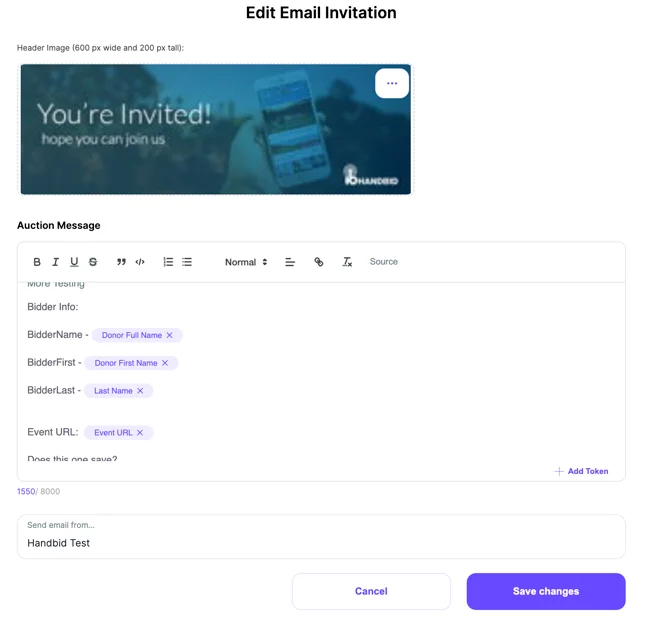
Automation tools, pre-built marketing templates, and built-in social sharing buttons all help you promote your event and sell more tickets. Look for an event management solution that includes these features, and take full advantage of them during the planning and marketing stages of your fundraiser.

How to Promote Your Event on Social Media
Now, let’s dive into some channel-specific event promotion ideas. Check out several ways to promote your event on social media:

7. Create Facebook Posts, Stories, & Events
With over 3 billion monthly active users, Facebook is still a very effective way to get the word out about your event. There are several ways to reach people on Facebook, including:
- Facebook posts. Posting to your feed (and inviting your stakeholders and supporters to do the same) is the easiest way to market your event on Facebook, especially if it’s open to the public. When creating a post, always include photos or a video, and set the post’s privacy to “Public” so anyone can share it.
- Facebook stories. The “story” feature on Facebook allows you to share video, photos, and text just like a post, but they’re only available to your audience for 24 hours. Often, the urgency of “missing out” on information helps get more eyes on your content.
- Facebook events. A Facebook event is very similar to an Evite. You create the event, invite people, and they can RSVP and ask questions. You can even notify all invitees with event details and updates, like links to your mobile bidding app, and post photos in the group.
While there are several newer social media platforms, Facebook remains a giant and provides a lot of versatility for your event promotion.
8. Promote Your Event in Facebook Groups
Finding and interacting with relevant Facebook groups is another great way to promote your event on the platform. Facebook groups are designed for specific, niche audiences to discuss common interests in private. One might serve as a support group for the people your organization serves, while another helps like-minded professionals share industry news.
There are likely multiple Facebook groups full of people who could be interested in your event. Try joining relevant groups and sharing your event where applicable. Just make sure you check each group's rules and get permission from the administrators before posting.
9. Post on Instagram
Owned by Meta, Instagram operates very similarly to Facebook and has over 2 billion monthly active users (84% of whom are under 45!). Let’s take a look at a few ways that Instagram can help you promote your nonprofit’s event:
- Instagram posts. Like Facebook posts, Instagram posts can be created and shared with the general public, as long as your account is not private. You can post photos with details about your event in the caption, and people can repost or share to their own stories. The only difference is that Instagram will not link to your event website within the caption. Instead, include links in your account bio and individual stories.
- Hashtags. Hashtags are a great way to boost your event’s discoverability, as long as they’re relevant and easy to search. For example, relevant hashtags for a silent auction in Boston could include #SilentAuction, #BostonFundraiser, and #LocalBostonEvents.
- Instagram stories. Stories help you engage your audience in real time, making them a great way to promote your event and share key announcements. Unlike posts, stories can link directly to your event or ticketing website. Additionally, they include several interactive features you can experiment with, such as quizzes, polls, and Q&A boxes.
10. Film TikToks or Reels
While we recognize that TikTok and Instagram Reels have significant traction in the social media space, these pieces of content can take time to reach the right audience, which may not be the best strategy for promoting your event. This form of content marketing takes a lot of time, creativity, and effort, and your event may be over by the time your TikTok video reaches the right people.
However, you can leverage short-form videos in other ways to boost your nonprofit’s reach. We suggest using this feature for more “long game” content, like your organization's overall mission or regular volunteering opportunities, instead of one-time events.
11. Ask Supporters to Share Your Content
Word of mouth is still an effective way to market events, and the power of social media takes it to a whole new level.
Whenever you post on your social media channels, encourage them to share your content. You might text or email your supporters to ask them to share your posts. With the right event management software, you can even give guests the opportunity to share the event and specific auction items while they participate on the day of. For example, check out this social sharing feature that lets guests share via text, email, or Instagram with just a few clicks:
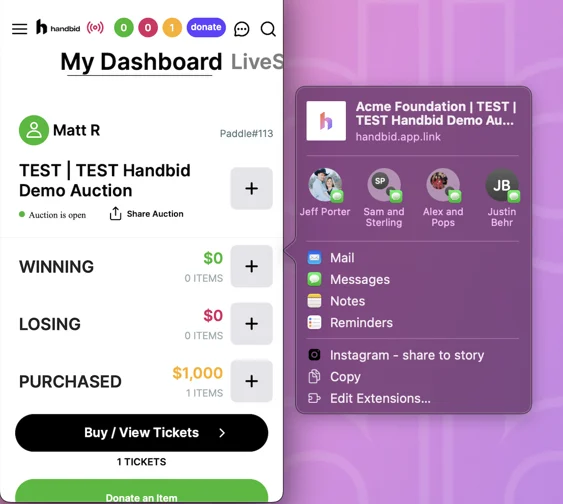
Sharing content costs supporters nothing and takes less than 10 seconds. No matter when or where they decide to share your event promotions, it’ll help you boost engagement.
Other Ways to Promote Nonprofit Events Online
12. Send Evites
An Evite is a digital invitation you email to individual supporters. There are many types of Evites available from sites like Punchbowl or Eventbrite, ranging from a one-page website to a fully animated invitation experience.
With Evites, you can upload the email addresses of the people you want to invite, manage your RSVP list, and send announcements and reminders about your event. However, you are mostly limited to the people whose email addresses you have, so reaching the public might be more challenging with this marketing tactic.
13. Post on Community Websites
There are many community websites that exist solely to share information about local events. Often, these sites are hosted by local news stations, magazines, and even social media influencers. Most of the time, it’s free to post your event on their website and gain more exposure in the local community.
14. Use the Google Ad Grant
Paid media and advertising options can be very costly, making it difficult for most organizations to take advantage of them. However, there are programs in place that enable nonprofit organizations to use these platforms for free or at a reduced cost.
For example, Google rolled out its Google Ad Grants program in 2003 to offer eligible nonprofit organizations $10,000 per month in Google Ad credits. This means that nonprofits enrolled in the program can organize Google Ad campaigns worth up to $10,000 each month, for free. To qualify, your organization must hold 501(c)(3) status, not be a government, healthcare, or educational organization, meet Google’s website requirements, and complete an application.
Traditional Event Promotion Tactics
15. Design Paper Advertisements
It’s a myth that marketing is only effective in the digital realm. Direct mailings, door hangers, and flyers are not dead. In fact, businesses have seen a 49% increase in sales just by combining email and print marketing.
There are many ways to effectively reach any audience through good, old-fashioned paper. Here are a few of them:
- Traditional invitations: Especially if you’re hosting a gala or more formal event, creating formal invitations could be a good way to reach your audience, especially if they have attended your event in the past. Try hand-addressing each envelope for that special touch.
- Direct mail or door hangers: Some companies will help you place door hangers, mail postcards, or create coupon book inserts to send to people within your desired geographic area. This may be a good route if you’re hoping to attract a large local audience to your event.
- Flyers: Create a catchy flyer with bold colors and detailed information about your event. Then place them in strategic areas around your event location, such as bulletin boards, office lobbies, or even inside bathroom stalls.
- QR codes: The QR code made a great comeback in 2020, and you can use it to your advantage when promoting your event. You can make your own QR code with a site like QR Code Generator so people can scan it and join your event in seconds.
16. Promote Your Event on the Radio
Radio stations will sometimes promote your event for free, especially if it interests their listeners. For example, if you’re hosting a benefit concert, contact a radio station that would be most likely to play the band’s music, and ask them to mention your event on their morning show and in commercials during the weeks leading up to your event.
17. Send Text Message Reminders
While we believe that email, social media, and word of mouth are effective and necessary ways to promote your event, sending a text message is currently the fastest way to reach your donor base.
As you shop for event software, look for a texting feature. This way, you’ll be able to send messages to past supporters and current guests with information about your event and giving campaigns. For example, you might send an SMS invitation to your auction like this:

Get creative with your texting strategy when you can. Share item sneak peeks, quick reminders about downloading your event app, or calls to action that ask them to send the link to your event website to their friends!
FAQs About Promoting Nonprofit Events
When should you start promoting your event?
Your event promotion timeline will depend on your location, demographics, and how people have responded to your past events. Some nonprofits host the same event every year and always see guests register at the very last minute. However, a good best practice is to start marketing your event six to eight weeks out. Create a timeline of which channels you’ll start with, plan out the frequency of your messaging, and measure your progress along the way.
How often should you repeat your message?
Even if you choose multiple avenues to promote your event (and we think you definitely should), you'll still have to send your message several times. People need repetition and reminders about your event—it’s said that people need to see a message seven times before they take action. You should never assume that people see your message the first time you send it.
But don’t let that discourage you! Instead, let it be a reminder to make yourself sound like a broken record and post as often as possible so more people see your message and information.
How can software help you promote charity events?
The right fundraising event software can streamline your marketing efforts as well as event management, hosting, and ticket sales. Certain platforms offer built-in social sharing features, email and SMS communication tools, and other functionality that helps you expand your nonprofit’s reach.
Final Thoughts on How to Promote Your Event
Promoting your fundraising event is crucial for its success. With the right approach and a diversified marketing strategy, you can generate excitement and enthusiasm for your fundraising event and reach your goals. Just remember to center your audience and track engagement! Event software like Handbid will help you shift your strategy as needed to maximize your event’s impact.