

Organizing a silent auction involves several moving parts, and one such activity is choosing starting bids and bidding increments that set your auction items up for success. Ultimately, the goal is for your auction items to generate more revenue than your event budget and knock your fundraising goals out of the park. But that requires careful, strategic planning.
Our customers often ask us how they should set up these bidding rules, so today, we’ll share some ideas on how to price silent auction items fairly and effectively. We’ll cover these steps:
- Determine the Fair Market Value (FMV)
- Set Silent Auction Starting Bids
- Choose Your Minimum Bidding Increments
- Optional: Add a Buy-It-Now Price

Silent Auction Pricing Terms to Know
When it comes to pricing your organization’s silent auction items, you must understand these terms:
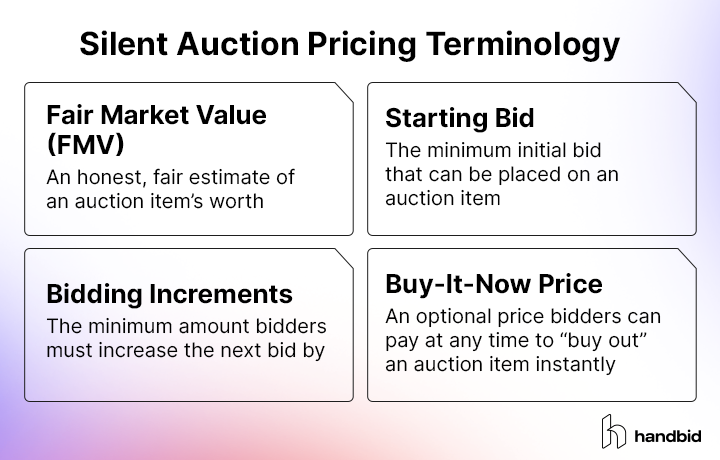
- Fair Market Value (FMV): An honest, fair estimate of an auction item’s worth based on similar items’ pricing
- Starting bid: The minimum initial bid that can be placed on an auction item
- Bidding increment: The minimum amount bidders must increase the next bid by (such as $10 or $50)
- Buy-It-Now price: An optional price bidders can pay at any time to “buy out” an auction item instantly
Here’s an example scenario of how your guests will interact with each element of auction pricing:
A guest walks up to an auction item that no one has bid on yet. They see that the item is worth $1,000, but the starting bid is only $400. Thinking it’s a steal, they bid $400. When a second guest approaches, they see that they must increase the bid by at least $50, so they bid $450. This goes on until a big spender decides they want the item no matter what. They decide to purchase the item for the Buy-It-Now price ($2,000, for example) and end the bidding.
This terminology is essential for creating an effective silent auction pricing strategy, whether you host your events in person or online, with or without traditional bid sheets. The decisions you make about each one will have a major impact on your auction’s results, so make sure you give equal attention to them all.
1. Determine the Fair Market Value (FMV)
It's critical to be honest yet fair with FMV. A $50 gift certificate is clearly worth $50. However, a painting’s value may be less clear, so make sure you estimate the FMV reasonably.
An accurate FMV will help you better understand how guests will bid. Plus, bidders will appreciate it, since they can only claim deductions on their purchase amount, which might ultimately be less than the FMV.
Most auction rules require item donors to report the FMV of their items, but they may inflate those values for their own purposes. So don't just take their word for it! Here’s how you can estimate FMV for yourself:
Tangible Items
For tangible items, search the internet and check what that exact item is selling for. If it’s unique, see what similar items are priced at online. Try to get any memorabilia authenticated by a professional to ensure accuracy.
Pro tip: Double-check FMVs for one-of-a-kind items. We had a donor once tell us that a baseball signed by an MLB player was worth $250. An internet search found it available from multiple places for $75.
Intangible Items
For intangible items like travel packages and unique experiences, FMV can be harder to determine. To get a good estimate, you can:
- Research the prices of similar intangible items at other fundraising auctions.
- Consider your audience, past fundraising performance, and other item sales to determine how much guests would be willing to pay.
- Ask supporters directly what they might pay for the intangible item.
Important Note: Many people will tell you to set your starting bid at a percentage of FMV (e.g., 30%). If your fair market value is inflated, however, this will create a steep entry point for your item. If you plan to base your starting bids on fair market value, keep in mind that FMV can be subjective, especially for intangible assets. So be careful.
2. Set Silent Auction Starting Bids
Now that you have your item’s FMV, set a reasonable starting price that looks like a great deal to bidders.
As we mentioned, some advisors will tell you to set silent auction starting bids to roughly 30-40% of the item’s FMV (or even 50% for big-ticket items!). We think auction pricing is more of an art than a science, and formulas don't always work. Our years of data crunching have shown us that bidding increments actually have a bigger influence on overall auction performance than many organizers think.
We think 30-40% of FMV is an okay place to start, but auctions only work well once people are engaged. To get them engaged, you need a low (but fair) entry point.
If you set the starting bid price too high, you will price out some people—even those who may have eventually paid a price higher than the starting bid. This is because once people get engaged in bidding on an item, they're likely to get emotionally attached to it, causing them to bid higher. If the item has a high starting bid, however, it will be harder for the guest to justify that first bid.
3. Choose Your Minimum Bidding Increments
We have similar advice here—although many fundraisers use a formula to determine bidding increments, we believe they should be kept as low as possible.
In most cases, people set bid increments way too high, especially for more expensive silent auction items. Think of it this way: For an item with an FMV of $1,250, a standard starting bid that’s 40% of FMV would be $500, and increments that are 15% of the minimum bid would be $75. This automatically prices out anyone who would have paid $500-$575 or $575-$650.
The Formula Approach
If you are the type that absolutely needs a formula, here is a better one to consider:
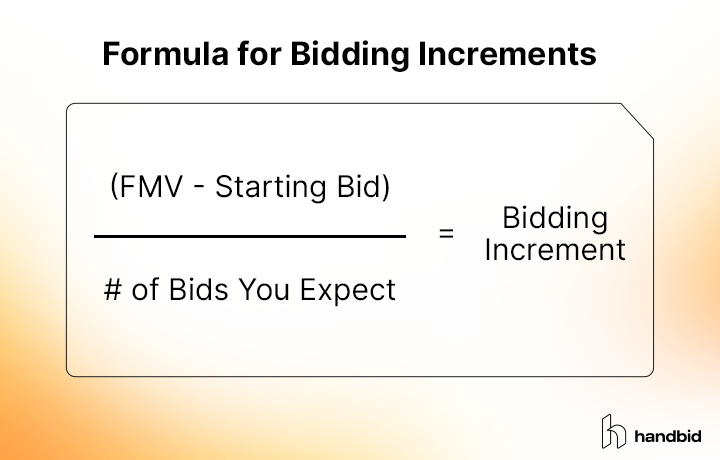
(FMV - Starting Bid) / # of Bids You Expect = Bidding Increment
Suppose you want to see roughly 13-15 bids for an item worth $1,250 with a starting bid of $500. For this specific example, you would calculate:
- $1,250 [FMV] - $500 [starting bid] = 750
- 750 / 15 = $50
Even if only 13 people bid on the item, you still earn $1,150. Getting $1,150 for a $1,250 item is a 92% efficiency and would be considered a success in almost any auction.
The Non-Formula Approach
Your other option is to keep bidding increments as low as you can stomach to get people engaged in the auction. Have an item starting at $1,000? $100 doesn't have to be the bid increment. Consider something less, like $25. It's not heresy. It is ok! If you get enough traction on the item, it will go for much more than $1,025!
Perhaps with a paper bid sheet auction, some of these ratios and high bidding increments make more sense. There is a high cost for a bidder to keep returning to a piece of paper to increase their bid. However, mobile bidding allows you to keep bid increments lower, since guests will be more willing and able to whip out their phones and up their bids.
4. Optional: Add a Buy-It-Now Price
Some items might be so exciting that eager bidders are willing to pay double the price to win them without a bidding war. In these cases, having a Buy-It-Now option is win-win for everyone. Guests get to secure their win instantly, and your organization gets more fundraising revenue than you might have after a full night of bidding.
If you do add this option, guests using your mobile bidding app can easily click the “Buy Now” button and beat out the competition in seconds. For example, here’s what that looks like in Handbid’s auction platform:
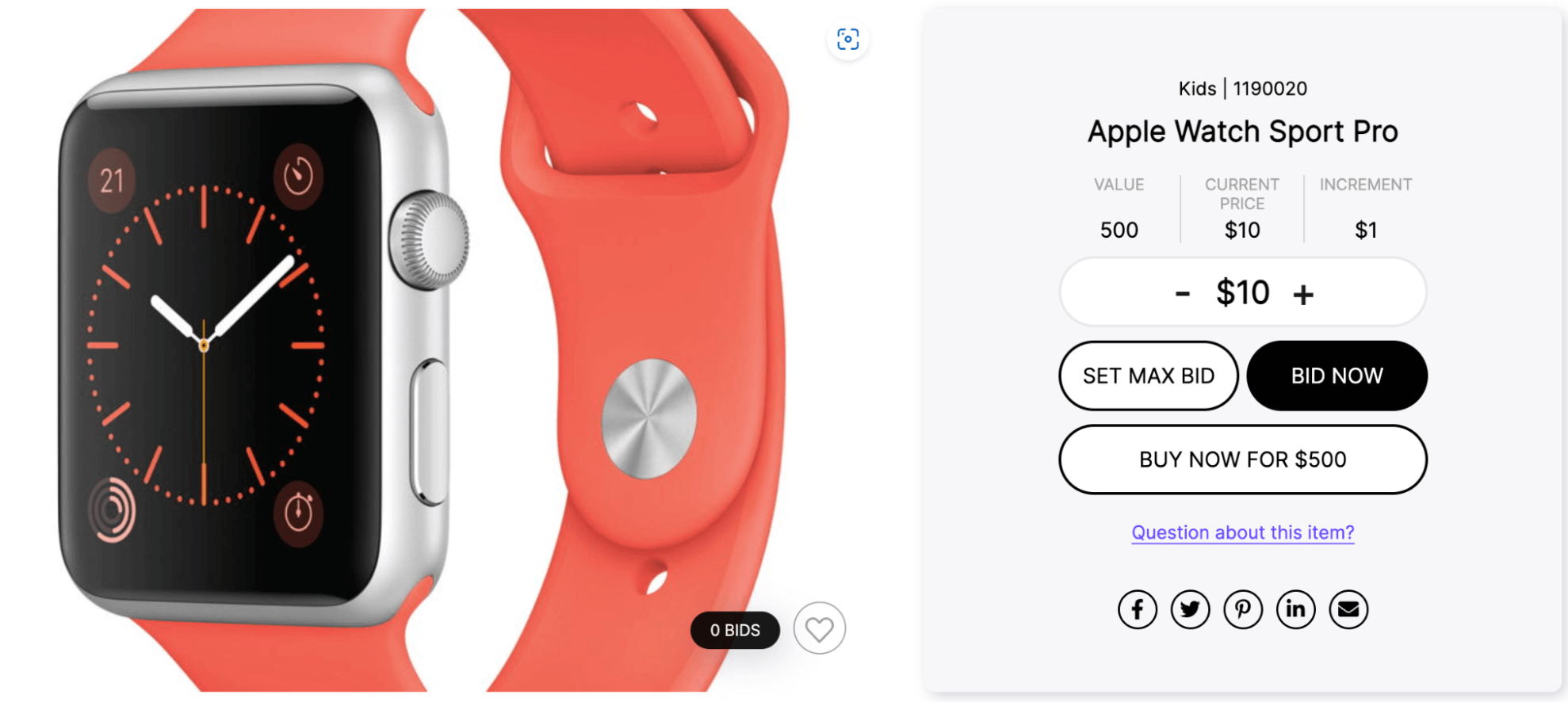
To earn sufficient revenue from bidders who are willing to go above and beyond to win, set your Buy-It-Now prices at 150-200% of the item’s FMV. Setting a high price point for this option typically won’t hurt!
Pricing Silent Auction Items with Handbid
With Handbid’s intuitive auction platform, it’s easier than ever to set fair silent auction prices and adjust them as needed. Plus, bidding becomes faster, more fun, and more profitable when guests can jump into bidding wars right from their phones. Combine fair pricing with easy access, and you’ll unlock a winning fundraising auction.
Need more advice before you launch your next event? Check out these additional resources for more silent auction planning tips:
- Silent Auctions: The Complete Guide for Smarter Fundraising
- 50+ Top Silent Auction Items & Ideas for Your Next Event
- 9 Essential Silent Auction Rules + Free Template