


If you or your donors are confused by auction item tax deductions, you’re not alone. Determining the potential tax benefits of donating or bidding on items at your fundraising auction is tricky—thanks to something called fair market value (FMV).
FMV directly impacts supporters’ charitable tax benefits, so nonprofits have to be careful when setting and communicating these values. In this quick guide, we’ll break down the basics of both auction item tax deductions and fair market value so your organization is better prepared to host its next auction.
Disclaimer: This blog is not meant to communicate any tax advice. Everyone should consult a tax advisor regarding their specific auction, organization, donors, and bidders to determine tax deduction eligibility.

Are Silent Auction Items Tax-Deductible?
Silent auction items may be tax-deductible for nonprofit supporters, depending on the value of the item and the amount the winning bidder pays for it.
The IRS has specific rules for charity auctions, dictating that:
“Donors who purchase items at a charity auction may claim a charitable contribution deduction for the excess of the purchase price paid for an item over its fair market value. The donor must be able to show, however, that he or she knew that the value of the item was less than the amount paid.”
What Is Fair Market Value (FMV)?

Fair market value (FMV) is the estimated amount of money an auction item is worth or that a buyer would reasonably pay a seller for the item under normal conditions. The value is an estimate because some auction item values aren’t straightforward. For example, a laptop that can be bought online for $1,000 would have an FMV of $1,000. However, jewelry made by a local artist or a “Principal for a Day” experience may not have an obvious monetary value.
FMV isn't just an indicator of how much an item should raise for the auction. It’s also important for tax reporting, since FMV has direct implications on whether your auction items are tax-deductible for donors.
Breaking Down Charity Auction Tax Deductions
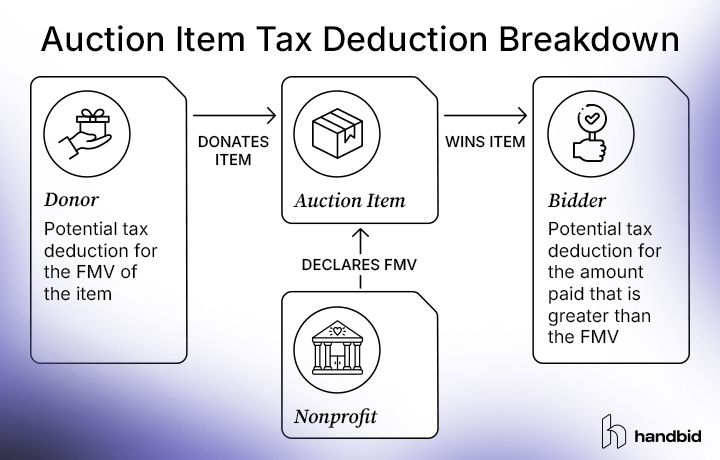
There are multiple parties involved in a charity auction transaction, and it is often unclear who qualifies for a deduction. That’s why we created this diagram to illustrate the relationship between the parties involved in a charity auction:
Tax Deductions for Auction Item Donors
In this case, “donors” are the individuals or businesses that donate auction items to your nonprofit as in-kind contributions. For tax purposes, here’s how it typically breaks down:
- The donor provides the auction time and, often, its estimated FMV (though not in all cases).
- Your nonprofit lists the item for auction and declares its fair market value (FMV), along with the item’s starting price at your event.
- The donor is typically able to claim a deduction based on the value of the item donated. However, the amount and nature of that deduction are subject to some complicated IRS rules.
Tax Deductions for Auction Item Bidders
Once the donated item is up for auction at your nonprofit’s event, guests will bid on it and raise the final price until you declare a winner. The check-out transaction is called a "quid pro quo” transaction, which limits the winner’s tax deduction to the difference between the amount they paid and the fair market value.
Ideally, the final amount they pay is higher than the item’s FMV, but this doesn’t always happen. If an item is unpopular and you set the starting bid below the FMV, for example, the winner might end up paying less than the item is actually worth. In this case, the winner would not be able to claim a tax deduction.
Tax Deduction Fair Market Value Considerations for Nonprofits
Estimating FMV accurately is vital for organizations hosting auctions, since it impacts the winning bidder's ability to claim a tax deduction. However, we find that there are many misconceptions about how tax deductions work in a charity auction, and fair market value is at the center of the confusion.
To make your auction item FMVs as accurate and clear as possible, follow these tips:

- Ask donors to provide an estimated FMV. Your donors should provide an estimate of the fair market value of items they donate, but keep in mind that these estimates won’t always be accurate.
- Verify FMV online. Confirm an item's fair market value by researching comparable products or services for sale online.
- Consider the cost of materials for homemade items. When auction items are homemade, we recommend setting the FMV to the cost of the materials. For example, if the item is a painting made by a class at school, the FMV should be the cost of the paint, canvas, and frame.
- Avoid setting FMVs too high. Overestimating FMV may reduce or even eliminate the deduction your winning bidders can claim.
- Never set auction item FMVs as “priceless.” While saying items are priceless may be a tactic to attract bids, it is not an appropriate value for an auction item, since bidders cannot claim a tax deduction. In fact, Handbid’s nonprofit auction software does NOT allow you to set a value as priceless.
When helping our customers import items, we often run into issues with item values. That’s why Handbid requires that every item have a specific value (although you have the option to not reveal it to bidders until it prints on their invoice).
Navigating Auction Item Tax Deductions and Fair Market Value
Claiming tax deductions for auction items is often confusing, but it’s likely that your guests will want to know about the potential tax benefits of their contributions. When you understand the basics, you’ll be better prepared to answer questions and engage supporters in bidding.
Remember, tax deductions aren’t always straightforward, so always consult a registered tax advisor if you have any doubts!